

Keepa is by far the most important tool for anyone trying to sell on Amazon.
It gives you all of the necessary information to make an informed buying decision if you understand how to use it.
In this post we’ll go over the basics of using Keepa, what to look for and some examples of good and bad products.
What is Keepa?
Keepa is a tool that tracks the sales history for all items on Amazon.
From the date an item goes up for sale you can see how much it’s sold for, how many people have sold it, and other important information.
There is no other tool on the market that can do what Keepa does - which is why I don’t understand how they’re only charging ~$22/month for it.
Keepa tracks a lot of different data points, but in this post we’re going to focus on just six of them.
Sales Rank
Sales rank is how well an item is selling relative to the rest of the items in its category.
For example, a book with a sales rank of 1 is the best selling book on Amazon.
A “good” sales rank is relative since each category has a different amount of items being sold.
For larger categories like Shoes & Clothing 300k might be a decent sales rank.
For smaller categories like Pet Supplies you’ll want to stay under 75k.
Sales rank in Keepa is shown as a green line:

An ideal sales rank chart is constantly going up and down, meaning that the item is selling units on a regular basis.
New + Buy Box Price
The “New” price is in blue, while the “Buy Box” price is in purple.
New tracks the lowest price on the listing, while Buy Box tracks the Buy Box price.
In case you weren’t aware, the Buy Box is the featured offer on an Amazon listing where you go to add a product to your cart.
Notice how in the following image that the Buy Box price is almost always higher than the New price:

Good products will have a buy box line that is somewhat consistent (fluctuating up and down a couple dollars is perfectly fine).
A common misconception is that you need to be the lowest price to win the buy box and get sales - this is not true at all.
As long as you are competitively priced (within $1-$3 of the other buy box sellers) you should be able to get sales.
There’s no need to race to the bottom.
Amazon Price
A gold shaded area indicates that Amazon was selling on the listing and for how much.

Most people think that you’re unable to compete with Amazon, but that’s not necessarily true.
There are some special cases where you can share sales with Amazon on a listing but if you’re a beginner I recommend staying away from these types of products for now.
New Offer Count
Below the main Keepa chart that shows sales rank and price, there is a secondary chart that shows the offer count.

This line tells you how many people have been actively selling on the product at any point in time.
Knowing how much competition exists on a listing is important for being able to determine how many units you can sell.
If an item is selling 100 units per month and there are 4 sellers, we can estimate that as the 5th seller on the listing we would be able to sell around 20 units per month.
Putting It All Together
Your typical Keepa chart with all the attributes we care about looks something like this:
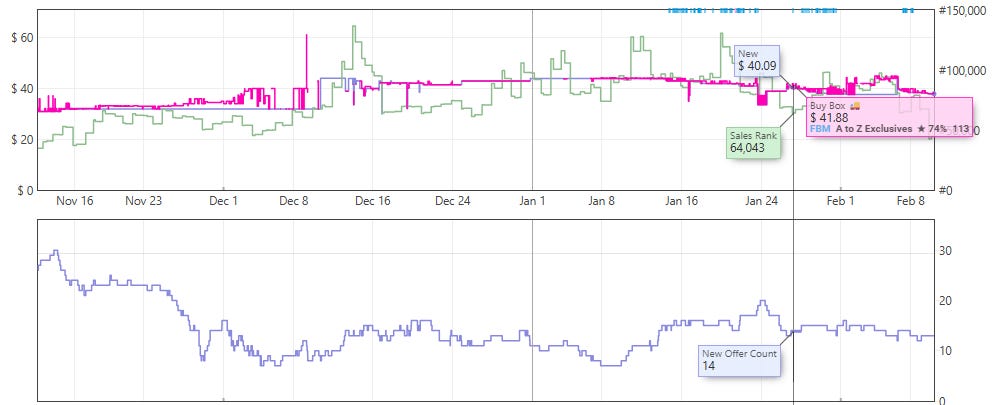
This item has a relatively stable sales rank and price, without a ridiculous amount of competition.
If we could find it at a profitable price, I’d have no issues buying some units.
Red Flags
Now that you have an idea of what you should be looking for when evaluating Keepa graphs, let’s go over some common red flags and types of items to avoid.
Seller Count Increase
This one is a classic - seller count rapidly increases and the price quickly drops anywhere from 10-50% in a matter of days.
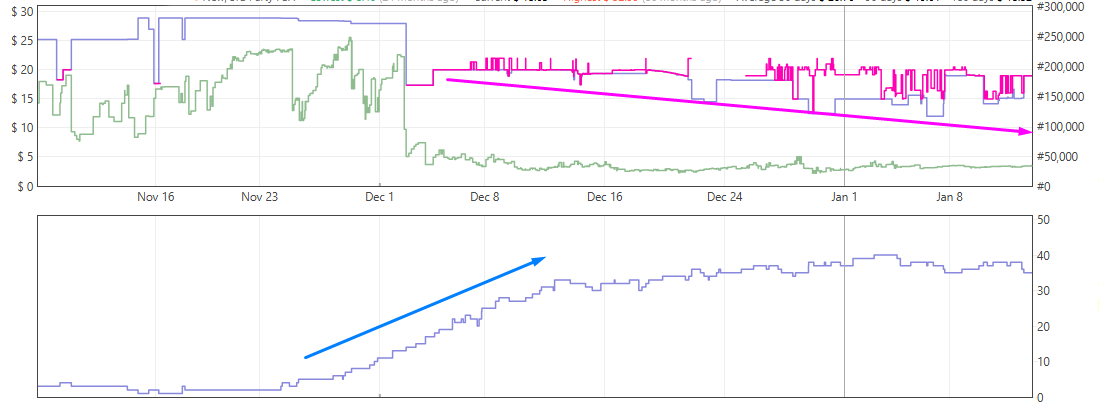
Items will typically fall into this category for two reasons:
The item went up for clearance on a popular retail website (Walmart, Target, etc.) where almost everyone can see it
Someone posted this product to a leads list (a paid service where someone gives you a list of items to buy - you can read more about them here if you’re a paid sub)
Items that are easily accessible attract lots of competition, which is why you need to be cautious when purchasing items from the biggest retail chains.
Otherwise you end up in a trap where you think you found a winner, only to see 50 other sellers competing alongside you and racing to the bottom with pricing in order to get rid of their stock.
Seasonal Products
Seasonal products are a great way to increase revenue during specific times of the year as long as you can identify when those items are going to be in demand.
A big mistake I see from new sellers is blindly buying these products without understanding the future demand of said products.
Here is a chart for a hoodie from a popular clothing brand:
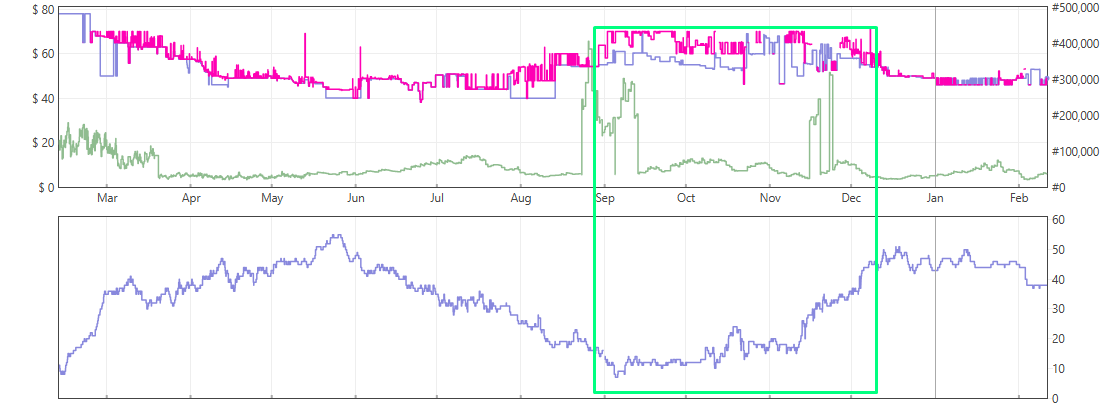
As indicated by the green rectangle, the demand and prices are the highest from September-December when temperatures start to drop.
A huge mistake that people make is buying these items when they go on clearance in February / March.
This is a bad idea because the demand won’t be as high, and as such you’ll be fighting the other sellers who made the same mistake to offload your inventory.
One thing leads to another and eventually you’re racing to the bottom with pricing trying to offload your last 2 hoodies in the middle of June.
This also applies to holiday themed products - there’s no point buying Christmas decorations in December because you won’t have them stocked and ready to be sold until after Christmas is over.
Seasonal products can be very profitable, but you need to do your research and purchase them weeks in advance to capitalize on the short window of demand.
Brand Direct Seller
One type of product you need to stay away from is items that are being sold directly by the brand in question.
A couple of ways you can identify these products include:
The buy box price rarely (or never) changes
The seller with the majority of the buy box share is the name of the brand or the company that owns the brand
Seller count is mostly flat
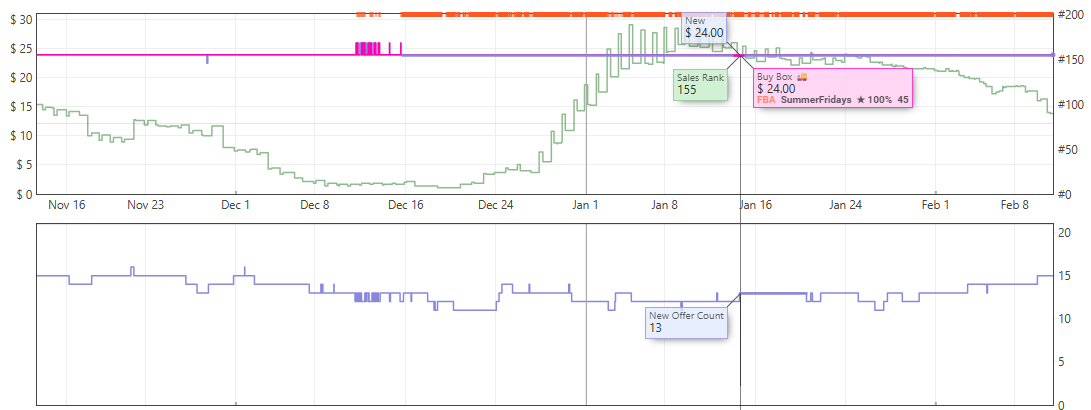
In this example we can see a product from the brand Summer Fridays, with Summer Fridays clearly having the majority of the buy box share.
Competing with brands directly is almost always a bad idea - even if you can find the item profitably, there’s nothing stopping them from kicking you off the listing via IP complaints or by threatening you with lawsuits.
If you’re serious about building a successful Amazon business, there’s two ways I can help you:
Check out my course Arbitrage Tactics, which gives you a step-by-step guide on how to scale your store to six figures and beyond.
Sign up for my email list, where I occasionally offer 1 on 1 consulting (currently I am only accepting 1 client per month).